
Fistula surgery · Surat
Anal Fistula Surgery
Fistulotomy remains the gold standard. Laser and other sphincter-saving techniques are kept for selected cases, decided only after an examination.
- High success rate
- Sphincter preservation
- Complete healing
- Low recurrence
- Success rate
- 90%+
- Gold standard
- Fistulotomy
The condition
Understanding anal fistula
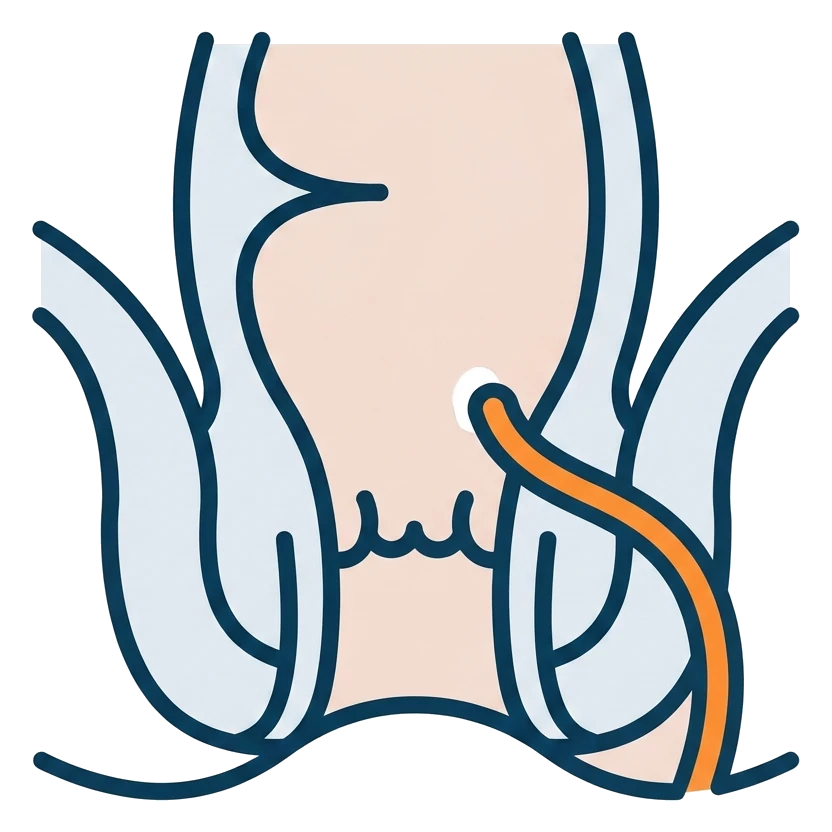
An anal fistula (fistula-in-ano) is an abnormal tunnel that forms between the inside of the anal canal and the skin near the anus. Most fistulas develop as a complication of an anal abscess that failed to heal properly.
The main challenge in treating fistulas is closing the tract completely while protecting the sphincter muscles that control bowel movements. Fistulotomy has the lowest chance of the fistula coming back; newer techniques such as laser or LIFT carry some chance of recurrence, so they are used only in selected cases.
Common symptoms
- 01 Persistent drainage or pus from an opening near anus
- 02 Pain and swelling around the anus
- 03 Recurring abscesses
- 04 Blood or discharge with stool
A hot, throbbing, swollen lump near the anus with fever is an abscess. It needs drainage soon, before any fistula surgery is planned.
Fistula paths explained
How a fistula tunnel runs
Doctors call a fistula simple or complex by how much of the sphincter muscle it crosses. Tap through the four common paths to see how each one runs. The path itself can only be found on examination.
Simple
Low and shallow
- The path
- Runs low, between or under the muscle rings, touching little or none of them.
- Why it matters
- Little or none of the muscle that controls the bowel lies across the tunnel.
- At the visit
- The path cannot be felt or seen from outside. Dr. Nikhil finds it on a gentle examination and explains your options.
Often simple
Through the muscle
- The path
- Goes straight through both muscle rings, part-way down.
- Why it matters
- Part of the muscle that controls the bowel lies across the tunnel, so it has to be protected.
- At the visit
- How much muscle is involved can only be judged on examination. Dr. Nikhil will talk you through what he finds.
Complex
High, over the top
- The path
- Loops up and over the top of the outer muscle before coming out.
- Why it matters
- A lot of muscle lies across the tunnel, so protecting bowel control is the main concern.
- At the visit
- An MRI scan may be advised to see the full path. Dr. Nikhil will explain the plan once he has examined you.
Complex
Branched or recurring
- The path
- Has side branches, or has come back after earlier surgery.
- Why it matters
- A missed branch is a common reason a fistula returns, so every branch needs to be found.
- At the visit
- An MRI scan often maps the branches. Dr. Nikhil will go over the findings and your options with you in person.

Reviewed by Dr. Nikhil Krishnani MBBS, MS, FALS · laser proctology (IMMAST)
This is a guide to help you talk to a doctor, not a diagnosis. Only an examination can confirm what you have.
Ask Dr. Nikhil on WhatsAppTreatment
Fistula treatment options
Fistulotomy, laying the tunnel open, is the gold standard. Laser, LIFT, seton and VAAFT are used only in selected cases, and each carries some chance of recurrence. Dr. Nikhil decides the technique after examining you.
- Gold standard
Fistulotomy
The tunnel is laid open so it heals from the base. The lowest chance of the fistula coming back.
-
Laser Fistulotomy
A laser fibre seals the tunnel from inside. For selected cases; some chance of recurrence.
-
LIFT Procedure
Ligation of Intersphincteric Fistula Tract: the tunnel is tied and divided between the muscle rings. For selected cases; some chance of recurrence.
-
Seton Placement
A soft thread placed in the tunnel so it drains and settles, sometimes before a final repair.
-
VAAFT
Video-Assisted Anal Fistula Treatment: a fine camera inside the tunnel to see and clean it. For selected cases.
What to expect
Before, during and after
- 01
Before
- Examination to find the outer and inner openings
- An MRI scan for complex or repeat fistulas, to map every branch
- Any active abscess is drained first
- Routine tests and a clear cost estimate
- 02
During
- Done under anaesthesia
- Fistulotomy, the gold standard, unless your examination points to another technique
- Sphincter muscle is protected at every step
- 03
After
- Usually home the same or next day
- Sitz baths, dressings and a soft diet
- Follow-up visits over 4–6 weeks while the tract heals
Recovery
Your recovery
Typical times. Your own plan depends on the procedure chosen and how you heal; Dr. Nikhil gives specific guidelines to each patient.
- Day 1–2 Home with pain tablets and dressing advice.
- Week 1 Back to light work for most simple fistulas.
- 4–6 weeks Follow-up visits as the tract closes from the inside.
- Staged cases A seton stays for some weeks before the final repair.
FAQs
Frequently asked questions
Answers by Dr. Nikhil Krishnani MBBS, MS, FALS · Surat
What is a fistula-in-ano?
What are the types of fistula?
Can fistula heal on its own?
Which fistula technique is best for me?
Other treatments
Book a consultation
Get expert fistula care
An examination, a clear explanation and honest advice. Book your consultation today.
You'll be seen by Dr. Nikhil Krishnani Personally, at every OPD · MBBS, MS, FALS