
Appendix surgery · Surat
Laparoscopic Appendix Removal
Appendicitis is a surgical emergency. Prompt keyhole removal of the inflamed appendix, through 3 small cuts, with less pain and a quicker return home.
- Emergency care
- 3 small cuts
- Less pain
- Quick recovery
- Minimal scarring
- Small cuts
- 3
- Get checked if suspected
- Same day
The condition
Understanding appendicitis
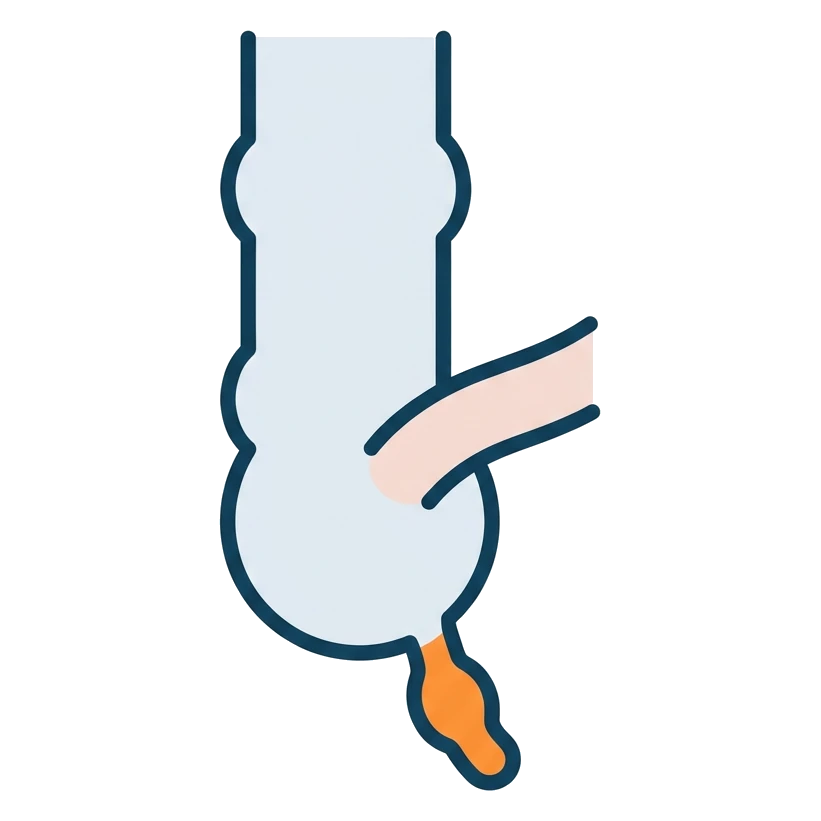
The appendix is a small, finger-shaped tube attached to the start of the large intestine, in the lower right belly. Appendicitis is when it becomes blocked and inflamed. It can happen at any age, but is most common in teenagers and young adults.
It is an emergency because an inflamed appendix can burst, spreading infection inside the abdomen. The standard treatment is to remove the appendix, usually by keyhole surgery (laparoscopic appendectomy). You can live a completely normal life without it.
Common symptoms
- 01 Pain that starts around the navel and moves to the lower right belly
- 02 Pain that gets worse on walking, coughing or going over bumps
- 03 Loss of appetite
- 04 Nausea or vomiting
- 05 A mild fever
Suspected appendicitis should be seen the same day; do not wait for it to settle or take laxatives. Severe pain across the whole belly, a hard tummy or a high fever can mean it has burst: go to the nearest hospital now.
Appendicitis signs
The signs of appendicitis
Tick what you feel to see what each sign means. Belly pain like this should be examined the same day, so please call rather than wait.
Tick what you feel
You will see what each sign means. Belly pain like this should be examined the same day, so if it is severe or getting worse, do not wait: call now.
Please be seen today
- This shift is the pattern doctors ask about first. Other organs nearby, such as the bowel, kidney or ovary, can also cause it.
- Pain that jolts with movement can mean the lining inside the belly is irritated.
- Not wanting to eat often comes with belly pain of many kinds, including appendicitis.
- Feeling sick is common with an inflamed appendix, and with many other tummy problems.
- A temperature can be a sign of inflammation or infection inside the belly.
Even one of these signs is worth an examination today, however mild it feels. Only an examination, and sometimes a blood test or scan, can tell what is causing the pain. Do not take laxatives or wait at home for it to settle, and have nothing to eat or drink until you are seen.
Go to the nearest hospital now
Severe pain across the whole belly or a hard tummy can mean the appendix has burst. Go to the nearest hospital emergency department now, and call on the way.
Can't get through? Go to the nearest hospital emergency department. Don't wait.

Reviewed by Dr. Nikhil Krishnani MBBS, MS, FALS · laser proctology (IMMAST)
This is a guide to help you talk to a doctor, not a diagnosis. Only an examination can confirm what you have.
Ask Dr. Nikhil on WhatsAppTreatment
How appendicitis is treated
An inflamed appendix is removed. The approach is chosen after an examination and a scan.
-
Laparoscopic appendectomy
The appendix is removed through 3 small cuts using a camera. Less pain, small scars and a quicker recovery, and the surgeon can look around the abdomen at the same time.
-
Open appendectomy
The appendix is removed through one small cut in the lower right belly. It is sometimes chosen, or switched to during surgery, for safety.
-
Antibiotics and drainage first
Sometimes an abscess is treated with antibiotics and drainage first, and the appendix is removed later. Dr. Nikhil decides this after examining you and seeing the scan.
What to expect
Before, during and after
- 01
Before
- Examination of the belly, blood tests and usually an ultrasound or CT scan
- Nothing to eat or drink once surgery is likely
- Fluids and antibiotics through a drip
- Surgery as soon as it is safe, often the same day
- 02
During
- General anaesthesia
- 3 small cuts and a camera
- Appendix removed, usually in about an hour
- 03
After
- Usually home in 1–2 days; longer if the appendix had burst
- Walking the same or next day
- Follow-up in about 1 week
Recovery
Your recovery
Typical times. Your own plan depends on the procedure chosen and how you heal; Dr. Nikhil gives specific guidelines to each patient.
- Days 1–3 Short walks and light activity at home.
- Week 1 Many patients are back to desk work or college.
- 1–2 weeks Normal daily activities.
- 4–6 weeks Heavy lifting and sport only after this, or as advised.
FAQs
Frequently asked questions
Answers by Dr. Nikhil Krishnani MBBS, MS, FALS · Surat
Is appendicitis an emergency?
How is appendicitis diagnosed?
Can appendicitis be treated with antibiotics alone?
Do I need my appendix?
How long is recovery after appendix surgery?
What happens if the appendix bursts?
Other treatments
Book a consultation
Pain in the lower right belly?
Do not wait for it to settle. Call now to be examined today, or book a consultation for planned care.
You'll be seen by Dr. Nikhil Krishnani Personally, at every OPD · MBBS, MS, FALS